
Guide
Quarantine area for electric vehicles: requirements, duration and costs
After an accident, an electric vehicle is usually stored on a quarantine parking space with a safety distance, because a damaged lithium-ion battery can catch fire with a delay. According to a ruling of the Regional Court of Koblenz (Landgericht Koblenz) of 4 May 2026, the acute fire risk has generally passed after around five days; for this period, the court considered EUR 76.16 gross per day to be reasonable. This page summarises what businesses that take in damaged electric vehicles need to expect.
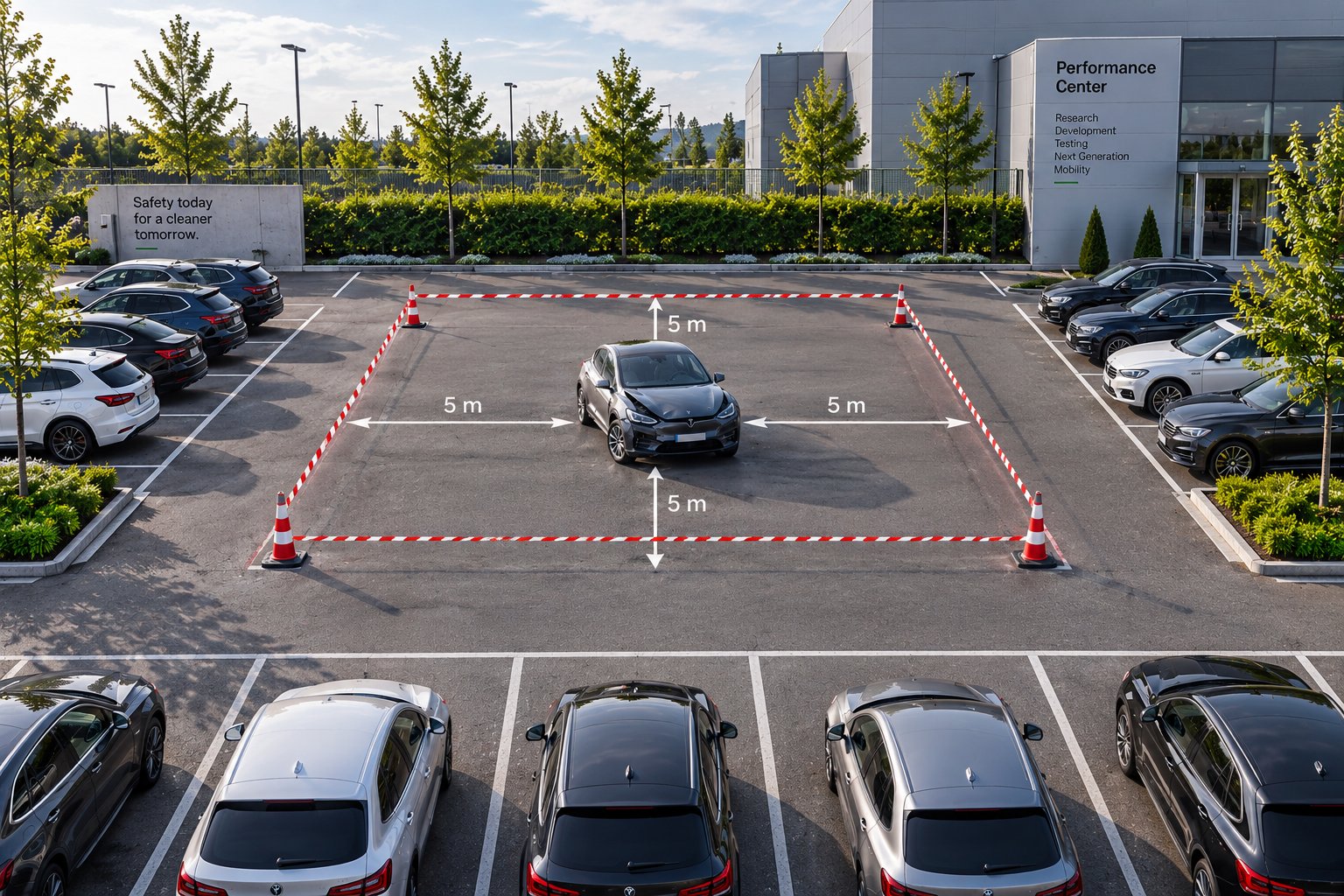
What happens after the accident
After recovery, a damaged electric vehicle is not parked like a combustion-engine vehicle. Because a mechanically damaged high-voltage battery can catch fire with a delay, the vehicle is stored on a quarantine parking space with a safety distance and monitored over several days. Whoever provides this space — towing company, workshop, car dealership or recycler — ties up space and bears the risk.
How long does the quarantine last?
There is no legally defined duration. Since May 2026, the key reference has been a ruling of the Regional Court of Koblenz (Landgericht Koblenz, case no. 14 O 169/24 of 4 May 2026): the court decided that the acute fire risk of a possibly damaged lithium-ion battery has generally passed after around five days. For these five days, it considered a daily rate of EUR 76.16 gross to be reasonable; for any further standing time, it only allowed the normal rate of an ordinary parking space. In the case decided, a vehicle had stood on the quarantine area for more than a year.
What does a day of storage cost?
The following figures come from the 2022 price and structure survey of the German recovery and towing association (Verband Bergen und Abschleppen). They show how differently the storage of an electric vehicle is billed — and that storage in a separate container is a category of its own with its own rate.
- Normal outdoor parking space (combustion engine)
- EUR 10 to 12 net
- Quarantine parking space for electric vehicles
- around EUR 80 on average, range EUR 25 to 150
- Storage in a separate container
- around EUR 248 on average, range EUR 65 to 350
- Considered reasonable by the court (first five days)
- EUR 76.16 gross
For the business providing the space, this is not a cost item but an invoice item. What matters is whether it holds up with the insurer: surcharges for high-voltage quarantine are regularly reduced or disputed. A tested measure with a certificate number and an expert assessment can be justified on technical grounds; an improvised cordoned-off area cannot.
Which requirements apply?
In Germany, there are currently no legally binding requirements for the storage of damaged lithium-ion batteries; industry recommendations and water law are what count. The frequently cited VdS 3103 is a guidance sheet from the insurance industry and was designed for intact, new lithium batteries. Also relevant in practice is the German AwSV ordinance: a damaged electric vehicle contains electrolyte, coolant and oils, and any fire water must be retained and disposed of as hazardous waste. Anyone who prepares an area has to provide this containment themselves.
What the industry recommendation says about distances
For technical quarantine areas, a joint project group of the German automotive associations VDA and VDIK, with the participation of GDV, VdS Schadenverhütung, DGUV, the German Fire Brigade Association, the recovery and towing association, ZDK and ZKF, has published recommendations (as of August 2022). According to these, a damaged electric vehicle is to be parked individually outdoors, on a paved and sealed surface with a drainage connection, in order to retain leaking operating fluids and contaminated fire water. Without additional fire protection measures, a distance of at least five metres from combustible objects and other vehicles is recommended; this recommendation is derived from Section 30 of the German Model Building Code (Musterbauordnung). The net parking space requirement of a vehicle of classes M1 and N1 is given as 5.00 × 2.50 metres.
Two points from this are decisive for businesses. First, the document explicitly names alternative operating concepts for cases where there is no suitable area on the premises — including a suitable container with sufficient ventilation and pressure relief. With such alternative concepts, the distance can be adjusted while maintaining fire protection requirements. Second, the document is explicitly non-binding: in individual cases, other safety precautions can also be accepted in consultation with the property insurer. Local building regulations must be observed in every case.
Sources: Technische Quarantäneflächen für beschädigte Fahrzeuge mit Lithium-Ionen-Batterien (technical quarantine areas for damaged vehicles with lithium-ion batteries), published by VDA and VDIK, as of August 2022; 2022 price and structure survey of the Verband Bergen und Abschleppen; Regional Court of Koblenz, judgment of 4 May 2026, case no. 14 O 169/24; German Ordinance on Facilities for Handling Substances Hazardous to Water (AwSV). This page as of October 2026. This page provides general information and does not constitute legal advice; the assessment in an individual case is the responsibility of the competent authority and the property insurer.
Open quarantine area or container?
Businesses that take in damaged electric vehicles have two options: prepare an area of their own and keep it permanently clear — or set down a tested container. The comparison shows what the decision comes down to in day-to-day operations. Whether a permit or consultation with the authorities is required for setting it up in an individual case depends on the applicable building regulations, the location and the use.
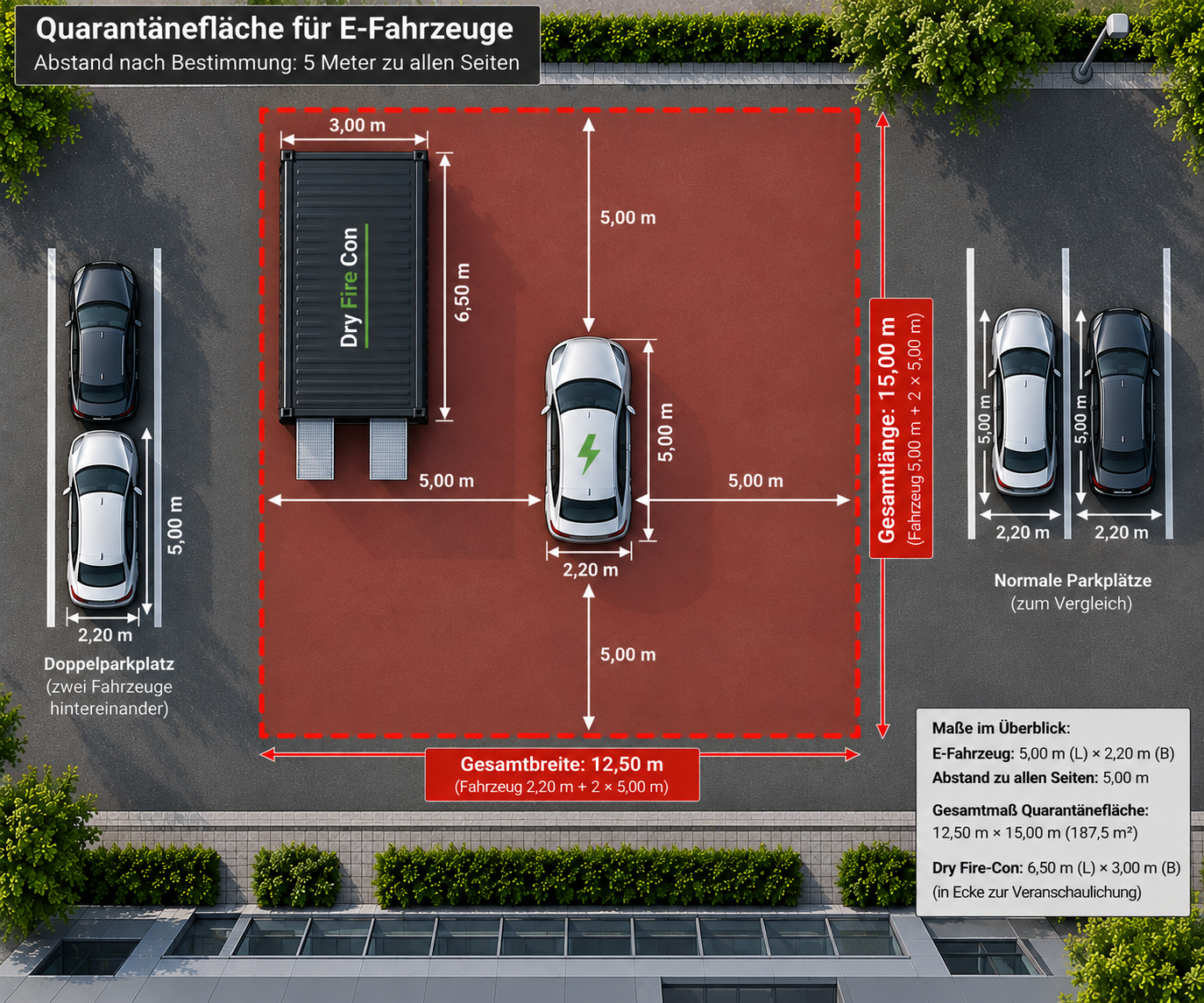
| Criterion | Open quarantine area | Dry Fire Con |
|---|---|---|
| Space required | Parking space plus safety distance, permanently tied up | Footprint of the container |
| Preparing the area | Containment, sealing where necessary and consultation with the authorities | No foundation, a paved, level surface is sufficient |
| Connections required | Fire water, depending on requirements | None, neither power nor fire water |
| After an incident | Contaminated fire water, containment under the AwSV, disposal as hazardous waste | Dry granulate, no fire water |
| Availability in daily operations | The area is also used in day-to-day business and has to be cleared first | Fixed, reserved space — ready to receive at any time |
| Removing the vehicle | Separate vehicle, reloading required | In the same container, TÜV certified to VDI 2700 Part 8 |
| Evidence for the insurer | None | Certificate, expert assessment and test report with number and date |
| Procurement | Construction investment, tied to one location | Purchase or rental, relocatable |
Suitable systems
Request a quote for your site
Tell us how many damaged vehicles you take in per year and how much space is available. We usually reply the same working day.
Request a quoteSolve quarantine without an area of your own
If you cannot or do not want to keep a space with a safety distance clear, you do not need a constructed quarantine area. The Dry Fire Con takes in the vehicle, works without fire water and stands on any paved, level surface.
We usually reply the same working day. In an acute case, it is better to call us directly: +49 171 755 68 21