
Battery storage container for lithium-ion batteries
Tested in a real fire test with a fully charged 100 kWh vehicle battery. Water-free, no power supply, no foundation. Purchase, rental and leasing.
Or call us directly: +49 171 755 68 21
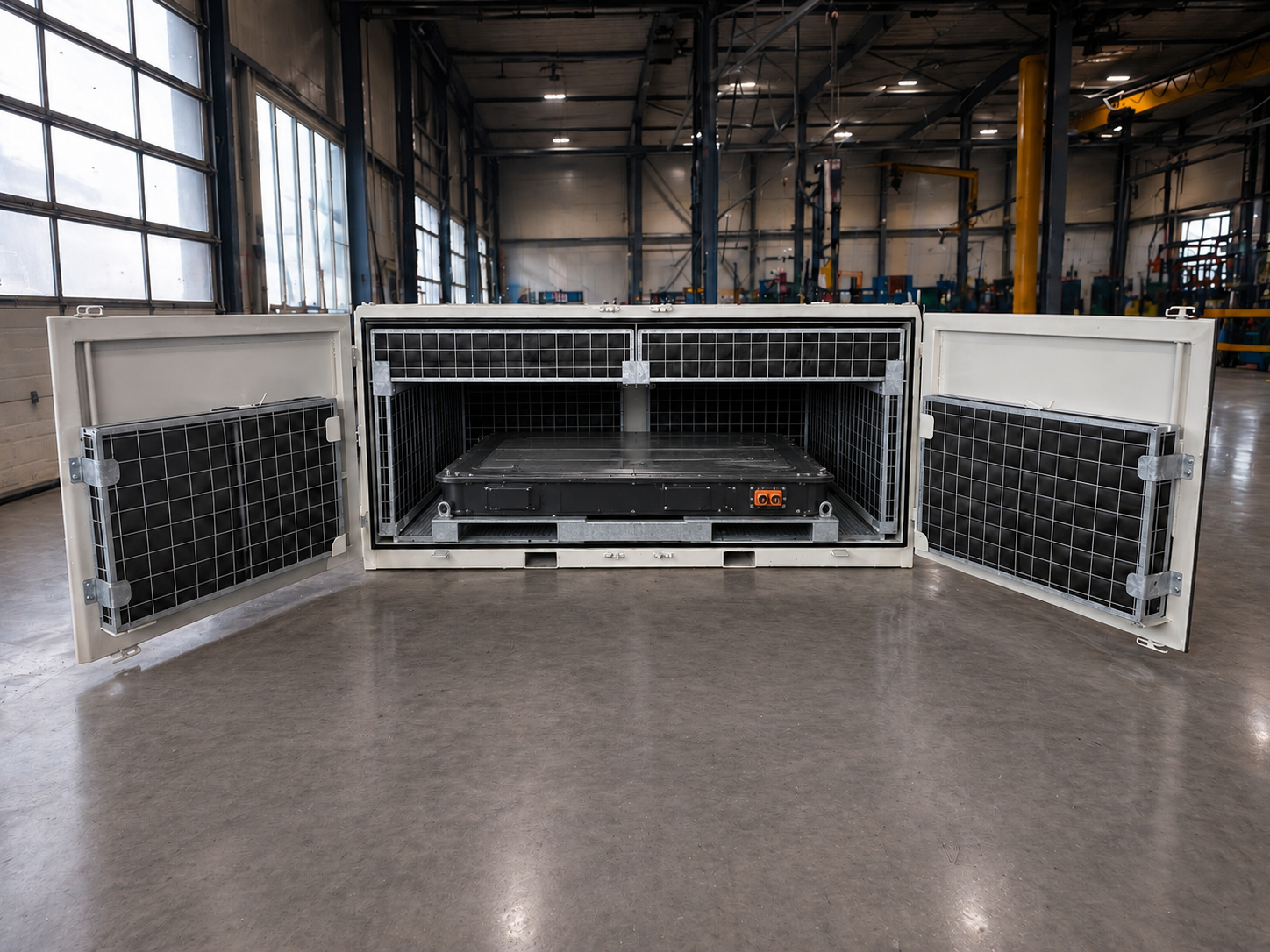
The Dry Fire Storage is a water-free storage container that works without a power supply, built for damaged, defective and inspection-pending lithium-ion batteries. Walls, floor, ceiling, doors and the intermediate deck are lined with the patented AkkuGrain granulate, which secures a thermal runaway without water, electricity or any further infrastructure. In the fire test carried out by Fraunhofer HHI against the test criteria of packing instructions LP906 and P911, no flames occurred outside the container, no fragments were ejected and hydrofluoric acid was not measurable at any time.
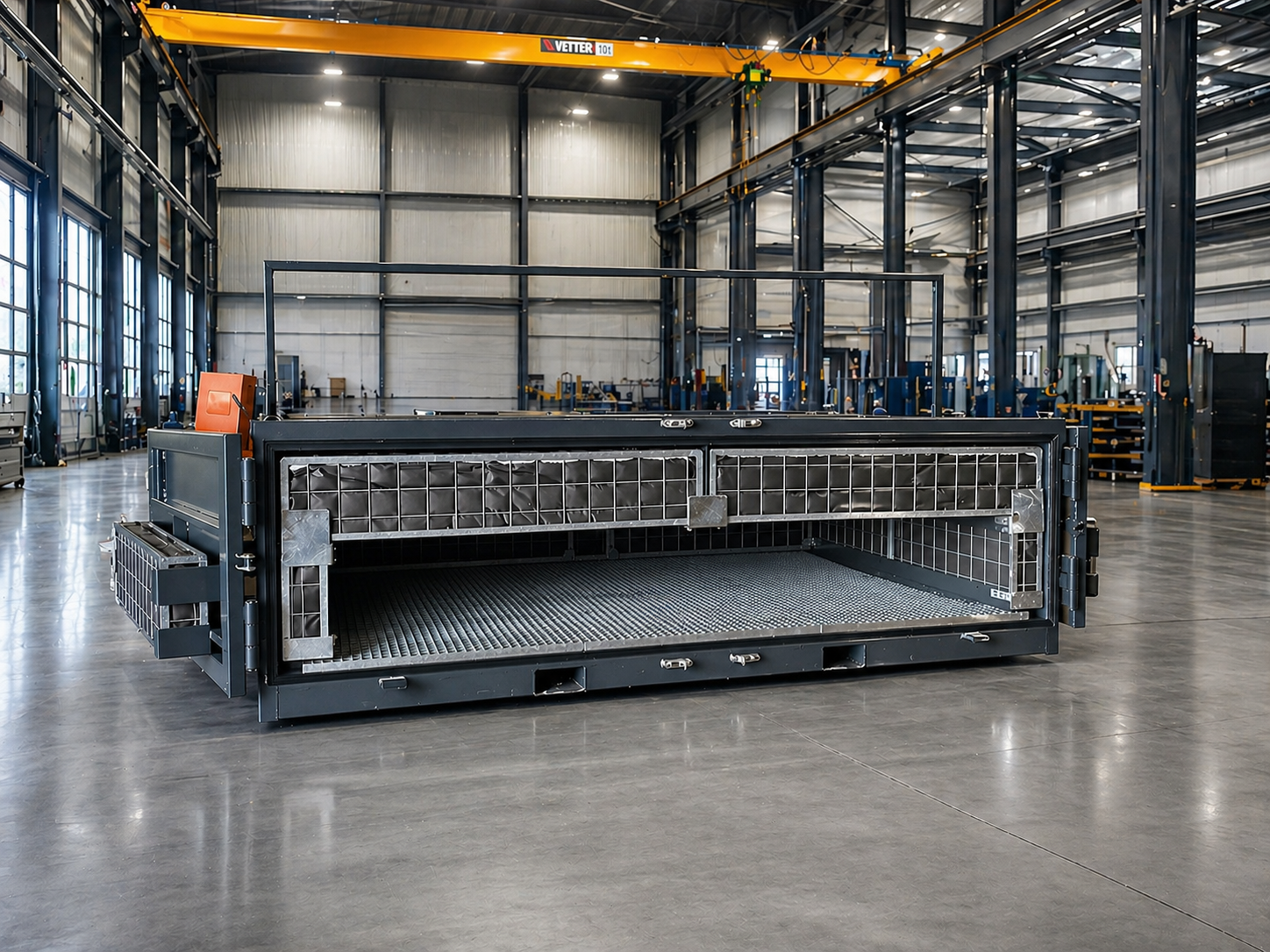
Where does the removed high-voltage battery go?
A removed or damaged traction battery rarely stays on site for just a few hours. Days or weeks pass until diagnosis, release, collection or recycling are arranged, and during that time it often sits in the hall, next to stock, production or staff. The Dry Fire Storage provides a closed space outdoors for this, one that holds even when the condition of the cells is unknown.
View all tests and certificatesWhat the Dry Fire Storage is built for
For everything that no longer belongs in a cabinet: damaged, defective or unclassified lithium-ion batteries that must be stored safely on site until they are collected, inspected or recycled.
Removed high-voltage batteries
In workshops and car dealerships, removed traction batteries often sit for days or weeks until diagnosis, release or collection. The Storage provides a defined place for them outside the hall.
Damaged and defective cells
Batteries with mechanical damage, an unclear condition or abnormalities must be kept apart from production, storage and staff. The granulate is already inside the container and works without being triggered.
Acceptance and interim storage
Waste management companies, recycling centres and recyclers take in batteries of differing origin and history. The container is a closed, lockable place for them.
Battery samples and testing
Test batteries and battery samples often have an unknown internal condition after test runs. The container stands lockable on the plant or test site.
How the AkkuGrain system works
Walls, floor, ceiling, doors and the intermediate deck of the container are lined with the patented AkkuGrain granulate. If a battery goes into thermal runaway, the granulate draws heat from the fire and binds the decomposition products of the conducting salt LiPF6, including hydrofluoric acid. Neither water nor electricity is needed, and nobody has to trigger anything or intervene. The pressure relief element vents the resulting overpressure to the outside in a controlled way instead of letting it build up inside the closed container.
For which application
The Dry Fire Storage is used wherever lithium-ion batteries are kept outside the vehicle. What matters in your sector is described on the respective page.
And for complete vehicles?
If a damaged electric vehicle is to be taken in as a whole, the Dry Fire Con is the right container. It is additionally certified by TÜV SÜD for load securing and is therefore also suitable for transport.
To the quarantine container for electric vehiclesTechnical data and test basis
The following details refer to the container tested in the fire test. We will state further sizes and versions in our quote.
- External dimensions of tested container
- 3,600 × 3,350 × 2,700 mm (H × W × L)
- Test basis
- Criteria of packing instructions LP906 and P911
- Test report
- 145-613-2023-0039.1, Fraunhofer HHI with VoltaLabs GmbH
- Test date
- 26 Oct 2023, published 15 Nov 2023
- Triggered battery in the test
- 100.8 kWh, 650 V, NCM 811, fully charged
- Lining
- AkkuGrain on walls, floor, ceiling, doors and intermediate deck
- Required connections
- none, neither power supply nor fire water
- Installation
- paved, level surface, no foundation
- Water protection
- integrated collection trays, designed to AwSV
- Procurement
- purchase, rental and leasing
The fire test: a fully charged 100 kWh battery, triggered inside the container
On 26 October 2023, the Dry Fire Storage was subjected to a real fire test by Fraunhofer HHI together with VoltaLabs GmbH in Goslar. It was not assessed by calculation but with a vehicle battery that was actually triggered (test report 145-613-2023-0039.1, published on 15 November 2023). The test followed the criteria of packing instructions LP906 and P911, which apply to critically defective lithium-ion batteries in the transport of dangerous goods. In the lower compartment, a fully charged vehicle battery with 100.8 kWh, 650 volts system voltage and NCM 811 cell chemistry was deliberately driven into thermal runaway; a second vehicle battery with 106 kWh was stored in the compartment above.
Result: during the propagation of around 50 minutes, no flames occurred outside the container, no fragments or debris were ejected, and the container was structurally fully intact after the test. The second battery in the upper compartment remained undamaged. Hydrofluoric acid was not measurable at any time; the permissible AEGL-2 value of 9.8 milligrams per cubic metre was never reached. The external temperature remained below 100 degrees Celsius throughout, except at the lower edge of one door, where it reached a maximum of 104.6 degrees for eleven minutes.
Under ADR, a container is not a packaging. Packing instructions LP906 and P911 do not apply to it directly; the container was tested against these test criteria but is not approved under them.
Overview of all tests and certificatesFrequently asked questions
A safety cabinet covers small quantities of intact batteries inside a building. As soon as damaged or defective batteries, large traction batteries or larger quantities are involved, the issue becomes separation from the building and containment. That is what a container standing outdoors is built for.
No. The Dry Fire Storage works without fire water and without a power supply, and it is installed without a foundation on a paved, level surface. A fire water system, a fire alarm system or any further infrastructure is not required. Whether a building permit or consultation with the authorities is needed for installation depends on the regional building regulations, the location and the use, and should be clarified case by case.
No, and that is not possible either: under ADR a container is not a packaging, so packing instructions P911 and LP906 do not apply to it. The container was nevertheless tested against exactly these test criteria. The Fraunhofer HHI test report shows that the required criteria are met and in part exceeded.
VdS 3103 is a guideline issued by the German insurance industry and was designed for intact, new lithium batteries; it applies only to a limited extent to damaged and defective batteries. The Dry Fire Storage is designed in line with VdS 3103 and with the guidance paper of the German federal and state working group on handling lithium-ion batteries under the AwSV. We compile the test documents for your discussion with your property insurer.
Yes. The container works without fire water, and the integrated collection trays ensure that no substances hazardous to water escape. The design follows the AwSV, the German ordinance on installations handling substances hazardous to water, and the associated guidance paper of the federal and state working group.
Yes. Purchase, rental and leasing are available. Which model makes sense depends on whether batteries are stored permanently or whether a single case needs to be secured.
That is what the Dry Fire Con is built for: a quarantine and fire-suppression container into which a complete vehicle is loaded and which is additionally certified for load securing to VDI 2700 Part 8.
Request a quote for your site
Tell us which batteries are to be stored, in what quantity and whether the cells are intact or damaged. We usually reply the same working day.
Request a quoteOr call us directly: +49 171 755 68 21
Request a quote for your site
Tell us which batteries are to be stored, in what quantity and in what condition. We usually reply the same working day.